
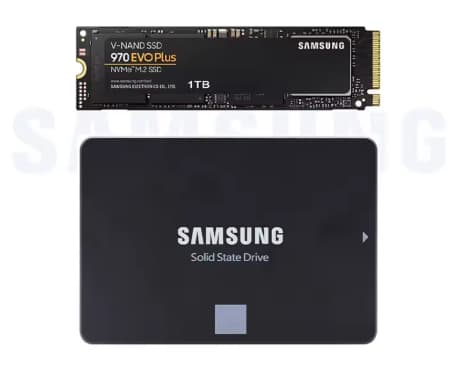
The Bottom Line: On paper, NVMe M.2 drives look like they obliterate standard SATA SSDs. But for everyday tasks like web browsing, running your business, and basic gaming, the real-world difference is practically zero. If you are building a reliable workhorse PC, a high-quality SATA drive is still an incredibly smart choice that can save you serious money.
The Spec Sheet Illusion: 7,000 MB/s vs. 560 MB/s
Hardware marketing relies heavily on massive numbers. A premium PCIe NVMe drive boasts speeds over 7,000 MB/s, while a top-tier SATA drive like the Samsung 870 EVO tops out at sequential read speeds of 560 MB/s and write speeds of 530 MB/s.
Mathematically, that makes NVMe look over ten times faster. However, those massive speeds only apply to sequential reads and writes—which means moving gigantic, unbroken files like 100GB 4K video projects.
The Real-World Bottleneck
- Booting Windows: Your operating system doesn’t load as one giant file; it loads thousands of tiny fragments. Both SATA and NVMe drives have near-instant latency for finding these fragments.
- Everyday Workflow: Whether you are coding a new website, running web hosting dashboards, or managing spreadsheets, the 560 MB/s cap of a SATA drive provides more than enough bandwidth. The drive is almost never fully saturated.
The Hardware Market: Why SATA is the Ultimate Budget Hack
With massive tech companies buying up global NAND flash memory supplies for AI data centers, consumer storage prices have spiked. Because of this, snagging a proven SATA SSD on the secondary market or during a steep sale is one of the smartest moves a builder can make.
If you manage to pick up a legendary 1TB Samsung 870 EVO for around $50, you have effectively bypassed the current market inflation while still securing top-tier reliability and a 1.5 million hour MTBF (Mean Time Between Failures) lifespan.
The Real-World Benchmark: Samsung 870 EVO
Using the Samsung 870 EVO in a modern build proves exactly why you don’t need to overspend. Paired with a solid B550M motherboard and an efficient processor, the system boots in seconds, opens applications instantly, and runs completely stable.
The 870 EVO features a robust MKX controller and a 600 TBW (Terabytes Written) endurance rating on the 1TB model, meaning it will easily outlast the useful life of most budget PCs.
The Verdict
If your motherboard has empty M.2 slots, buying a budget NVMe drive is great for cable management. But if you already own a high-quality SATA drive, or can find an incredible deal on one, do not feel pressured by the 7,000 MB/s marketing hype. A premium SATA SSD delivers the exact same snappy, responsive experience for your daily workload.